
A “beast of a beer,” Bigfoot by Sierra Nevada is one of my favorite styles of beer (even more so than IPAs): Barleywine. This style features ABVs comparable to most wines, ranging from 8 to 12 percent or more. Bigfoot sits at a comfortable 9.6 ABV. Barleywines also need a yeast with a strong wort and lots of sugar. The fermented sugars are what give this beer such a strong flavor profile.
The moniker ‘barleywine’ was given by Bass Brewing in the 1900s as a marketing gimmick tacked onto their No. 1 Burton Ale. Before the name barleywine, fortified ales went through a slew of labels such as ‘double,’ ‘double-double,’ ‘strong,’ ‘stock,’ and ‘old. Often ‘Ks’ and ‘Xs” were used to designate strength – the more Xs the stronger the beer.
Fun Fact: Professor Charles W. Bamforth, a Distinguished Professor Emeritus of Malting and Brewing Sciences at the University of California, once the quality assurance manager and research manager at Bass Brewing is now the senior quality advisor to Sierra Nevada brewing Company.
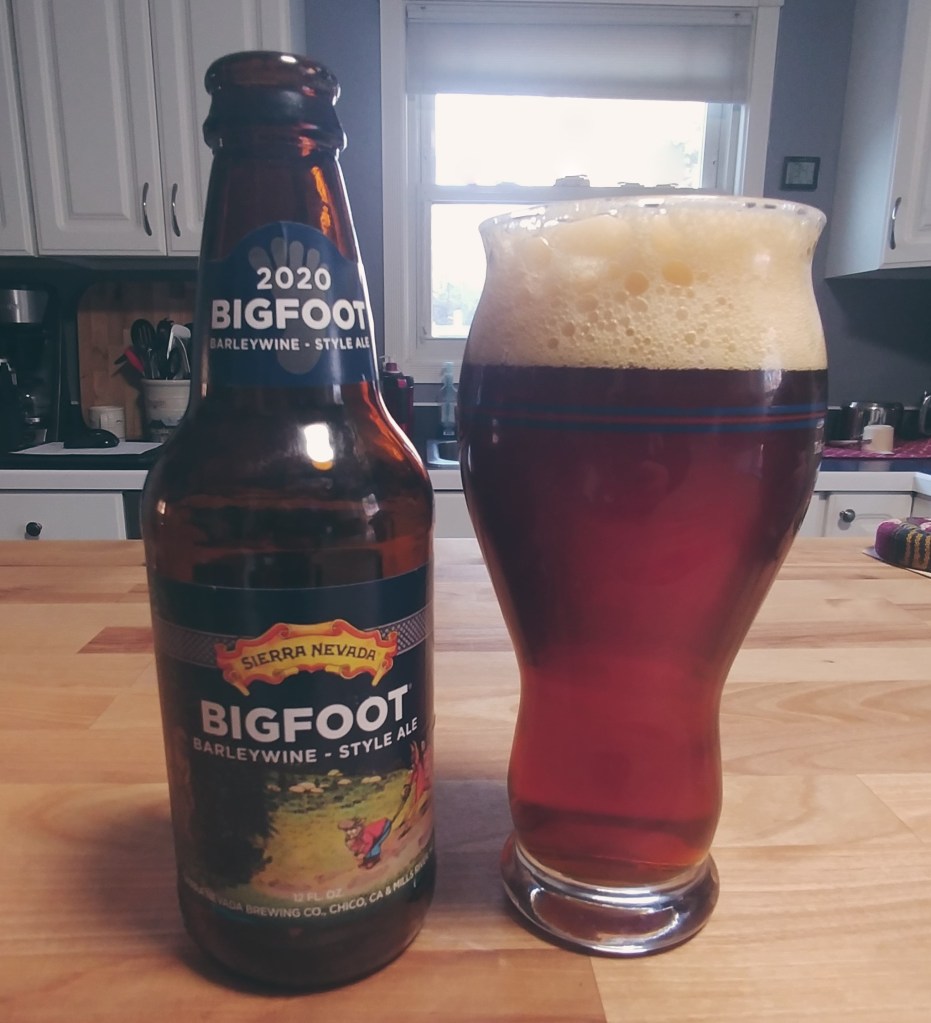
Sierra Nevada’s Bigfoot has been in production for some 20 years now. If you ever visit one of their locations you can do a vertical tasting of Bigfoot to see how the flavor changes from year to year (barleywines are great for cellaring). This is definitely on my wish-list!
Alright, let’s get down to the important stuff: flavor. Slightly boozy, but well balanced, Bigfoot starts off sweet and malty with a creamy, smooth feel on the tongue. There are some caramel and molasses notes as well, which in any other style of beer I wouldn’t be a fan of. I don’t even like caramel candy! That sweet profile is taken over by a mild bitterness towards the end which leaves a nice crisp toasty flavor in the mouth. It didn’t make the top of my list as far as barleywines go, but definitely something I’d drink again and keep stocked in the basement to age.
One very cool aspect of Sierra Nevada’s brewing style is their use of whole-cone hops. Here’s what they threw into Bigfoot:
Cascade
Originally developed by the open pollination of Fuggle and Serebrianka, Cascade was pioneered in the 1950s at Oregon State University by Jack Horner and his team. Released in 1972, this well known hop has become one of the most popular options and represents around 10% of all hops grown in the United States. It has a distinct floral aspect with elements of citrus and grapefruit.
Centennial
With a high alpha content, floral flavors and aroma, Centennial hops are well suited to Pale Ales and IPAs. Sometimes referred to as Super Cascade due to similar citric characteristics, this hop variety was developed in 1974 by Charles Zimmerman and S.T. Kenny at Washington State University. Its existence is due to a mix of Brewer’s Gold, Fuggle, East Kent Golding, and Bavarian hops.
Chinook
A cross between Petham Golding and a USDA male, Chinook is a versatile hop suited for American-style Pale Ales, IPAs, seasonal ales, barley wines, and the occasional porter or stout. Released in 1985, it’s known for its strong piney, spicy flavor with hints of grapefruit and is suitable for any stage of the boil.
Check out Bigfoot and other great beers from Sierra Nevada Brewing and be sure to continue supporting your local brew spots!
Cheers ~ Steph
 tiltedgnome.com